
Beyond “affordable housing”
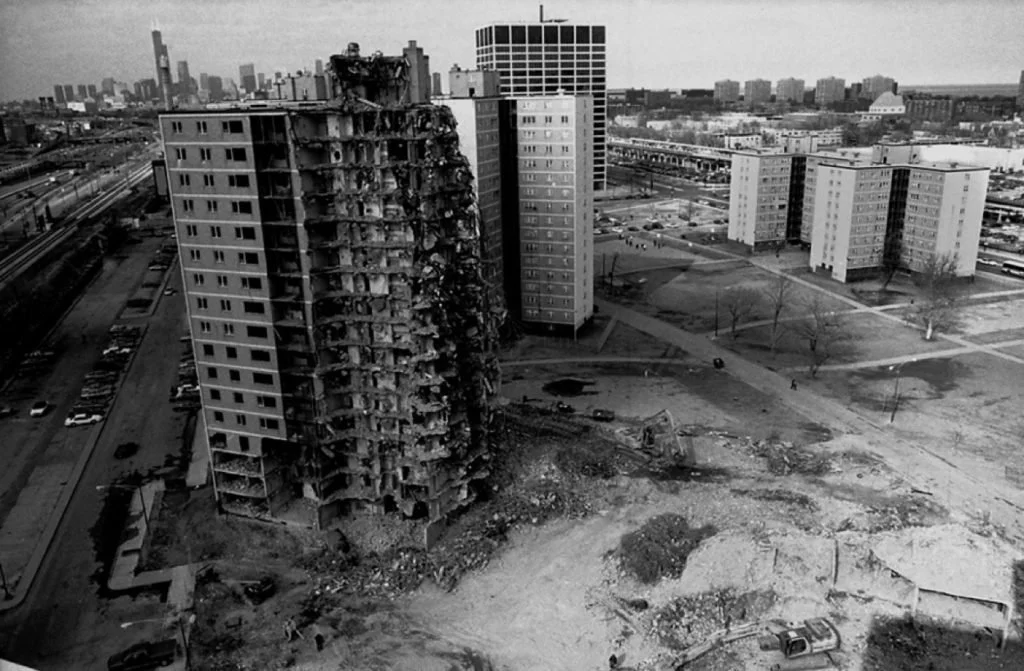
photo by Patricia Evans
A prevailing position among American progressives on how to address the housing crisis is to build more affordable housing. This term has a particular meaning and use beyond the simple question of price. A shack is affordable, but it is not affordable housing. Affordable housing can be understood as privately-owned, publicly-subsidized housing, wherein rent paid by a tenant is supplemented with government funding to the landlord. (1) Supplementary funding can come in the form of a voucher (paid to the landlord) or a tax credit (benefitting the landlord). This collaboration between the government and private landlord-developers has—oddly—become a cornerstone of progressive thinking around housing. Here we argue that affordable housing does little to address the problem of housing cost, and that progressives must embrace rent control and municipal ownership of housing if they are serious about affordability.
The social utility of affordable housing is a certain number of below-market units produced. Tenants in affordable housing pay less than the so-called “market rate” for rent in a given area. Often, the government makes up the difference between the affordable rate and the market rate with vouchers or tax breaks for the landlord. The market rate is, conveniently, determined by landlords and developers, meaning that the private sector tells the government what is or isn’t affordable, then asks for financial assistance to stay profitable.
Progressive politicians love affordable housing. Per her campaign website, New York Representative Alexandria Ocasio-Cortez has introduced a bill which would “incentivize local governments to promote affordable housing in their communities by offering additional funds to local governments that advance the public interest by taking measures such as streamlining permits and timelines to accelerate the building of affordable housing.” (2) Chicago Mayor Brandon Johnson, per his website, has promised to “reduce the cost to develop affordable housing by waiving fees for new affordable housing buildings, and fast-track zoning and building approvals so that affordable housing projects jump to the front of the queue.” (3) These statements, from two of the country’s most high-profile progressive elected officials, are characteristic of the affordable housing paradigm. They are pledges to incentivize local governments to streamline construction projects undertaken by the private sector.
This type of housing is in contrast to public housing, which is housing that is owned and operated by the government through the apparatus of a public housing authority, not private landlords receiving government subsidies. In public housing, rent is determined by a housing authority and paid directly to that authority by the tenant. It cuts out the middleman. But since the 1990s, thousands of public housing units have been demolished. Some former tenants have moved into newly-constructed Chicago Housing Authority (CHA) units, while many have transitioned to the precarious voucher system. Thousands have simply disappeared from CHA’s radar. According to a 2017 South Side Weekly report:
The CHA demolished Chicago’s largest and most notorious projects—Cabrini-Green on the North Side, Henry Horner on the West Side, and on the South Side an extensive ecosystem of public housing that included the Harold Ickes Homes, Stateway Gardens, the Ida B. Wells projects, and the Robert Taylor Homes—in order to replace them with new mixed-income developments. At the time of their demolition, housing projects in Bronzeville alone provided homes for at least 30,000 residents on government assistance. (4)
These tenants were told by the CHA that the demolitions were necessary to redevelop newer, cleaner, safer housing in their place. This promise has yet to materialize, and since the demolition of the high-rises began, CHA has lost contact with thousands of former tenants. Their fate is anyone’s guess. Meanwhile, a drive down State Street through Bronzeville could be characterized as neoliberal pastoral: vast swaths of empty green fields where housing once stood, where people once lived, and where the City promises that something magical is coming any day now.
The affordable housing model of “creeping privatization,” which relies on a byzantine system of vouchers and tax credits, has seriously weakened public housing. (5) That said, affordable housing does provide a social good: relatively cheap housing for those lucky enough to secure tenure. These tenants, who might otherwise be pushed out of the city or become unhoused, thus have the opportunity to remain in their communities—maybe. This is a positive outcome. But the piecemeal approach of affordable housing does little, if anything, to alleviate the overall problem of housing (un)affordability, and therefore little to address a primary cause of the housing crisis. On the contrary, it is specifically engineered to disrupt the housing market as little as possible, to ensure that surrounding home values are not impacted, and to keep landlordism profitable. According to some research, affordable housing actually increases surrounding property values. (6) Thus, while privately-owned affordable housing provides a lifeline to a lucky handful of qualifying individuals, the majority are left to contend with a brutal, market-rate housing hellscape. Some are saved, most are lost. And all the while, home prices—and as a result, rents—continue to rise. Not only that, but affordable housing projects funded by the Low Income Housing Tax Credit (LIHTC) are only required to comply with affordability requirements for thirty years. After that, these developments may transition to market rate, which for many tenants is functionally identical to a demolition. (7)
The legislative tinkering required for affordable housing is a far cry from the days of Robert Moses and Richard J. Daley, who with the might of the State smashed neighborhoods to erect iconic, but deeply troubled and segregated, public housing projects in their respective cities. Indeed the brutality of Moses and Daley, symbolized by the repeating form of the public housing high-rise, is often cited as a principal reason that midcentury-style public housing should never again be attempted. But we must take care not to conflate the methods of Moses and Daley and the aesthetics of the midcentury projects with the goals of public housing. Public housing is not inherently destructive or carceral. “Public housing” does not mean “concrete high-rise.” Public housing simply means housing owned by the State. It can—and must—be reformed and adapted for the twenty-first century.
Landlords and the real estate lobby have done tremendous work over the past three decades to fend off any effort to bring down housing costs. In 1997, the Illinois State Legislature passed the Rent Control Preemption Act, which removed Illinois municipalities’ ability to enact rent control policies within their own communities. (8) Landlords are allowed to raise rent as high as they want, and evict anyone who tries to stop them. As one Chicago organizer told us recently, “we have lost the war on housing in America.”
What is to be done? To start, Chicago progressives must loudly identify the catastrophic gains of the real estate lobby, and the need to dramatically move beyond affordable housing as a remedy to the crisis. Progressives must embrace and aggressively push policies which will actually bring down and control the cost of housing at large, while also regulating the ability of landlords to charge exorbitant rents. Two mechanisms will move us toward this goal: 1) rent control, and 2) municipal intervention in the housing market in the form of drastically-increased government ownership of housing.
The good news is that Chicago progressives have already embraced both of these solutions, though to varying degrees. On the issue of rent control, many elected officials are pushing to repeal the 1997 rent control ban. In 2017, Logan Square Representative Will Guzzardi introduced a bill which would overturn the 1997 law and return the question of rent control to municipalities, including the City of Chicago. Many progressive members of City Council support rent control. But until the State Legislature overturns the 1997 ban, City Council and its sizable progressive caucus cannot, by law, address the issue. If the Legislature succeeds, City Council will also need to enact “just cause” protections for tenants, which would require landlords to have a narrow reason not to renew someone’s lease. Without just cause, landlords could circumvent rent control by refusing to renew a tenant’s lease, then jacking up the rent for the next tenant. (9)
Repealing the ban on rent control is a daunting enough prospect, but launching meaningful City intervention in the housing market is even more so. Such intervention would be the most straightforward way to address the problem of housing cost, because aggressive movement by the City to control a sizable portion of cheap housing would provide a counterweight to the private housing market. Progressives should be honest about the goal of such action: it is to undercut the private housing market and drive down costs overall. It is not conciliatory, it is not meant to build bridges. It is an attack on the predatory private housing sector, by turning the power of the market against the real estate lobby. Tenant unions have already identified the class analysis at the heart of this struggle: tenants are directly at odds with landlords and the real estate lobby. Real estate’s material gains are tenants’ material losses.
This attack has been mounted before. At its peak, the CHA owned roughly forty thousand units. Since the new millennium, that number has plummeted to twenty thousand. Meanwhile, with public competition brought to heel, and with rent control outlawed, private landlords have hiked rents catastrophically. Unfortunately, in 1998, Congress capped the number of units that a public housing authority can build through a law called the Faircloth Amendment. This law limits the number of units that CHA can own to about forty-thousand. (10) But the CHA, according to the most up-to-date information from the Department of Housing and Urban Development (HUD), is still about twenty-thousand units shy of reaching the Faircloth limit. (11) In other words, the CHA can—right now—break ground on about twenty-thousand publicly-owned housing units which would compete directly with the private market.
Public housing advocates must contend with fifty years of anti-public-housing propaganda if they wish to win support for this critical endeavor. In Chicago, any time the phrase public housing is uttered, one is immediately met with the same hostile reaction: “Look what happened to Cabrini-Green.” In this city, the phrase Cabrini-Green is a synecdoche for all crime, violence, and political corruption associated with Chicago in the popular imagination. It is a phrase which evokes segregation, the Machine, the Drug Wars, the Daleys, and the brutal CPD all at once. It is an idea whose potency was distilled in the 1992 film Candyman, in which Cabrini-Green was conceived as a beehive where evil dwelt, and where anyone who crossed its threshold or was unlucky enough to be born inside was doomed.
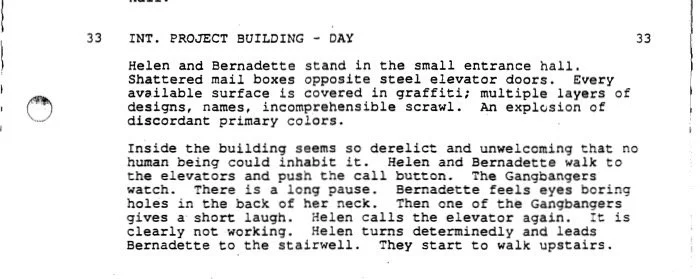
From Bernard Rose’s 1991 screenplay for Candyman. (12)
“Rebuild Cabrini-Green” is probably not a winning political slogan. But a return to large-scale City ownership of housing will be necessary if progressives are serious about bringing down the cost of housing and actually making cities affordable. Progressive politicians should use their platforms to combat historically sloppy (and racist) dismissals of public housing. The decline of Cabrini-Green, the Robert Taylor Homes, and Stateway Gardens was not due to the concept of public housing; it was due to years of racist neglect, segregationist city policies, and the slow, insidious rot of neoliberalism which has doomed most of this country’s social safety net. (13) What is the goal of the progressive movement if not to re-weave that tattered net?
New York City Mayor Zohran Mamdani, while not calling for an all-out public housing boom, has gestured toward public housing with more enthusiasm (at least publicly) than his peers in Chicago. Per his website, “federal, state, and city disinvestment have left NYCHA tenants with crumbling buildings and uncertain futures. Zohran will double the City’s capital investment in major renovations of NYCHA housing…” (14) (In a Zohran timeline, the elevators are working for Helen and Bernadette). The 2025 Mamdani landslide, which followed a campaign centered around affordability, tenants’ rights, and so-called sewer socialism, may be the strongest indication yet that the public is eager for a return to bold, municipalist solutions to social woes. The reactionary Candyman generation may be losing steam.
Mamdani’s description of NYCHA conditions echoes those within the CHA. We should not pretend that the CHA is, or ever has been, a perfect agency, or that its properties are utopian sanctuaries. The conditions facing tenants inside these buildings are indeed abhorrent, and shady property managers must be held accountable. Tenant unions can play a crucial role here, and will be necessary to protect tenants while also shifting building control from paternalistic bureaucracies toward democratic organizations of residents. Nevertheless, from the purely economic perspective of price, progressives must concede that creating more CHA units will weaken the private real estate market, which will bring down prices for tenants across the city and will result in more people housed. Bottom line: more CHA units means more money in Chicagoans’ pockets, less of it in their landlords’, and fewer people on the streets.
Social housing, which has a softer image than its twentieth-century precursor, is a concept that has gained popularity in recent years, including in Chicago, and may be the most politically palatable way forward. The Alliance for Housing Justice describes it in the following terms:
Social housing is a public option for housing. It is permanently and deeply affordable, under community control, and most importantly, exists outside of the speculative real estate market. Social housing can exist in different forms. It can be owned by public entities, residents or mission-driven nonprofits and occupied by renters or homeowners. It includes public housing, community land trusts, new construction, existing affordable housing, and conversion of current market-rate housing, and should meet the scale of the housing crisis. (15)
In May 2025, the Chicago City Council took a step toward social housing by passing the Green Social Housing (GSH) Ordinance. Unfortunately, GSH still tips its hat, unhelpfully, toward the private sector. According to a press release from the Mayor’s office, “RIC, the non-profit developer, will collaborate with private developers and retain majority ownership during construction and after stabilization. This model combines the efficiency of the private sector with lasting community benefits.” (16)
Anyone who has worked on a construction site in Chicago can speak to the alleged “efficiency of the private sector,” and it is a shame that private developers, even in the context of social housing, still benefit from this tired, neoliberal rhetoric, particularly when it comes from the pressroom of a progressive Mayor. That said, the conceptual ground has begun to shift in favor of social housing, which is a good sign. The phrase comes with less baggage than public housing, and the concept is better than affordable housing. The task for progressives is to prevent this important model from being colonized by private developers and becoming Affordable Housing 2.0.
In Chicago, the City has the right to control an additional twenty-thousand units of publicly-owned housing that stands outside—and competes directly with—the private housing market, right now. When it comes to housing policy, municipal ownership paired with tenant control and rent caps should be progressives’ fundamental goals if they are serious about affordability.
Notes
(1) Nick Bano, Against Landlords (Verso, 2025), 32.
(2) “Housing as a Human Right,” Alexandria Ocasio-Cortez for Congress, accessed January 24, 2026, https://www.ocasiocortez.com/issues#housing-as-a-human-right. Ocasio-Cortez also endorses the more radical position of repealing the Faircloth Amendment.
(3) “Affordable Housing,” Brandon for Chicago, accessed January 24, 2026, https://www.brandonforchicago.com/issues/afforable-housing.
(4) Jake Bittle, Srishti Kapur, and Jasmine Mithani, “Redeveloping the State Street Corridor,” South Side Weekly, January 31, 2027, accessed January 30, 2026, https://southsideweekly.com/chicago-unfulfilled-promise-rebuild-public-housing/.
(5) Kenton Card and Jan Breidenbach, “Bernie Should Declare Housing a Human Right,” Jacobin, August 5, 2019, accessed January 26, 2026, https://jacobin.com/2019/08/green-new-deal-housing-bernie-sanders.
(6) Christina Stacy and Christopher Davis, “Assessing the Impact of Affordable Housing on Nearby Property Values in Alexandria, Virginia,” (The Urban Institute, 2022), 2-3.
(7) Illinois Housing Development Authority, “LIHTC & Home Compliance Manual,” March 2023, accessed January 29, 2026, https://www.ihda.org/wp-content/uploads/2023/03/LIHTC-HOME-Manual-Updated-March-2023.pdf.
(8) Maya Dukmasova, “The secret history of Illinois’s rent control prohibition,” Chicago Reader May 16, 2017.
(9) This practice is already widespread in Chicago, with or without rent control. For more information on the push for Just Cause in Chicago, visit http://www.chihousingjustice.org/.
(10) “What is the Faircloth Amendment?”, National Coalition for the Homeless, accessed January 24, 2026, https://nationalhomeless.org/repeal-faircloth-amendment/.
(11) Office of Capital Improvements, U.S. Depart of Housing and Urban Development, accessed January 24, 2026, https://www.hud.gov/helping-americans/public-indian-housing-capfund.
(12) Bernard Rose, Candyman, 1991, 23, https://assets.scriptslug.com/live/pdf/scripts/candyman-1992.pdf?v=1729114882.
(13) Card and Breidenbach.
(14) “Housing by and For New York,” Zohran for New York City, February 2, 2025, accessed January 24, 2026, https://www.zohranfornyc.com/policies/housing-by-and-for-new-york.
(15) “What is Social Housing? Basic Principles for the US,” Alliance for Housing Justice, accessed January 24, 2026, https://www.allianceforhousingjustice.org/us-social-housing-principles.
(16) “Chicago City Council Passes Mayor Johnson’s Landmark Green Social Housing Ordinance,” Chicago Office of the Mayor, May 7, 2025, https://www.chicago.gov/city/en/depts/mayor/press_room/press_releases/2025/may/Green-Social-Housing-Ordinance-Passes.html.
